May 1 2013

Barkley

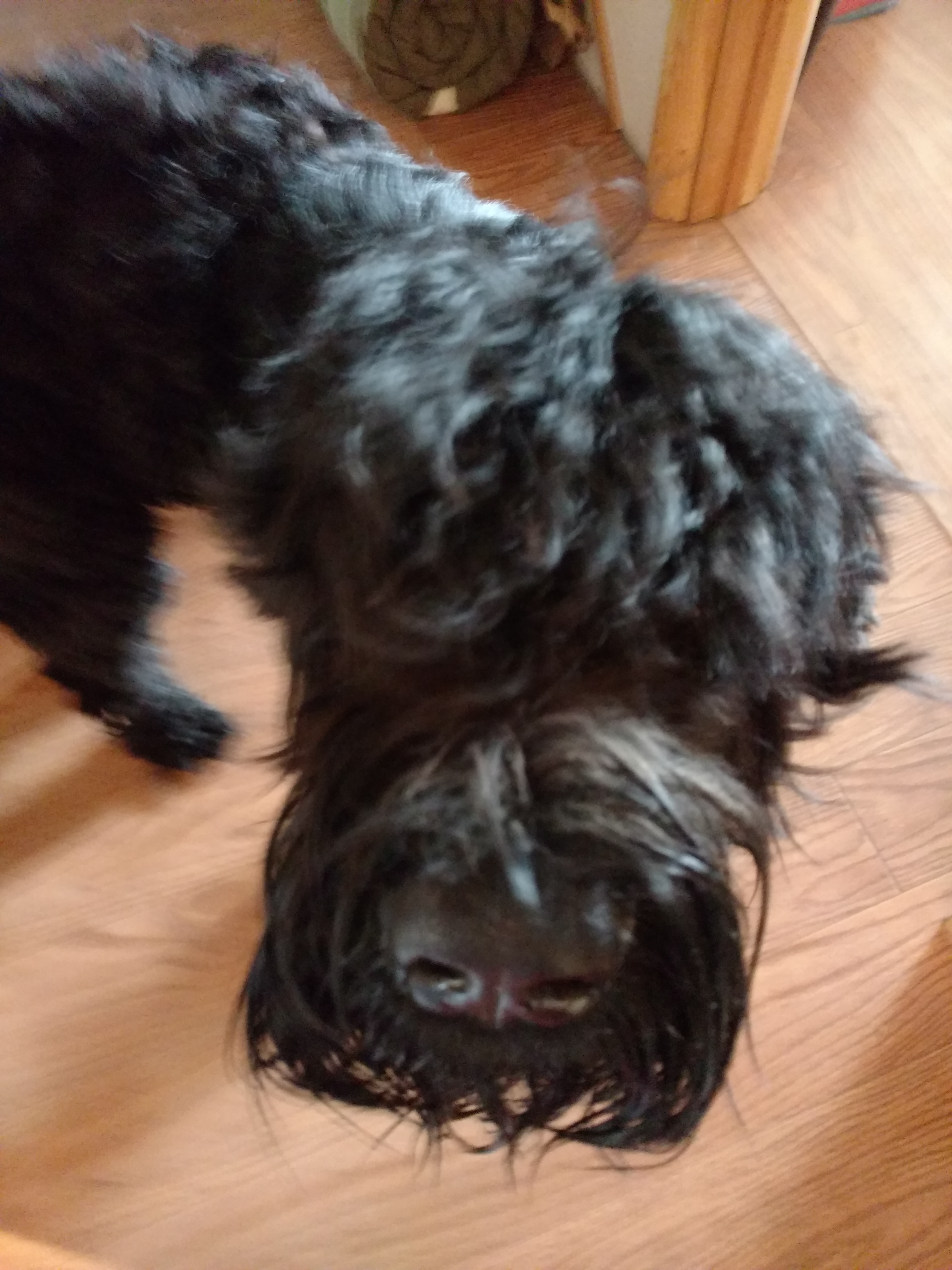
My dog is dying. He’s a Black Russian Terrier; an 8-10 year dog, as most large breeds are. We were told he was 2 when we got him, and we’ve had him for a full 8 years. It was inevitable, of course, that we would get to this point, one way or another. I just always thought, as we do — as we must — that there would be more time.

When we moved up into the mountains in 2005, we decided that Farmergirl would need a dog, so she could go hiking around our forest in relative safety. We wanted something big, loud, a little scary, and hypoallergenic. A friend of my mom’s at church offered us Barkley; she had 8 German Shepherds as well, and he and the alpha shepherd kept getting into squabbles over food, and Barkely kept losing. So we drove out north of Sandpoint, and met the dog. And he and the girl fell madly in love.

A Girl and Her Dog

We made arrangements to come back for him later in the month, and headed home. A week later, my mom got a call from her friend — Barkley and one of the other dogs had got into a squabble, the friend had tried to break them up, and now had 22 stitches in her arm and didn’t feel good about giving the dog to a household with a kid. Farmergirl was heart broken, sobbing late into the night — she didn’t want some other dog, she wanted this one. A few days later, the lady called again — did we want the dog still?

I called a dog trainer who attended the church and had met the dog, “Look,” I said, “If, in your professional opinion, you have any reservations about this dog, tell me, and I’ll drop it — but the kid and the dog really hit it off.” She opined that any dog can bite (agreed), but it seemed the dog had a good track record. The spousal unit came home. I proposed we take a trip up, and that he see the dog. “If you have the least reservation about him, we’ll come home and not mention it to the kid,” I said, “but I really had a good feeling about the dog.” We got up to Sandpoint, and the “22 stitches” were covered with a single bandaid. I knew she had also offered the dog to one of her husband’s colleagues, and suspected that he’d also said yes, took the dog home, and then decided against it. We made no comment, played with the dog, and loaded him up to come home with us. I’m 34 and this is my first dog — a rare breed that doesn’t start AKC registration for another year. My first dog is a rare breed, and I get it second hand.

Farmergirl was ecstatically over the moon. She did a happy dance, hugged the dog, danced some more. For about two weeks, he kept looking at us like, “Okay, guys, this has been fun — but you’re going to take me home now, right?” and we kept assuring him that he was home with us now.

And he’s been a good dog. He places himself on the edge of a room, so he can see everyone. He’s big, he’s loud, and he likes to walk in the woods. He accidentally bonded with me (that first week, we took off 7″ of matted hair, and had him neutered — I’ve always thought that he’s thought, “If this is what Jen does to “good dog,” I never want to hear “bad dog”). With the girl at camp, the grandparents away, a crate off in the future, and the house still under construction, the dog and I spent a long summer week with a stack of library books, biding our time and bonding. It’s a good thing, too: I’ve been scared of big dogs for as long as I can remember. I gave this one treats on the end of tongs for many months, because I was concerned I’d lose a finger. He really needed me to be the alpha, and I needed that, too.

Late Wednesday night (24 April), he went blind. Thurs morning, we got an appointment for Tuesday to see the Vet eye specialist downtown. Over the weekend, I taught him “step” (down a stair), and “up” (up the stair), so we could We made it down there and parked, then made our way around the building on the very new, very clean, very white sidewalk. He suddenly lagged and . . . there is went . . . 1, 2, “No! Stop! Go in the grass!” . . 3 . . . 4 . . . tail wagging. Argh. How to get the blind dog back past the landmines he just put right in the middle of the sidewalk to get to the baggies on the pole with the waste can. There’s a young woman coming this way, “Excuse me! Would you mind terribly grabbing one of those baggies on your way past?” She hands it to me, laughing, “My dog does that to me all the time.” I thank her and start a brand new task — picking up poop. 8 years of having a dog, and I’ve never performed this maneuver — we live in the country, and he goes off in the tall grass.

Inside, the doc looks at the dog’s eyes with various machinery and lights. He feels all over the dog. He says very little. “Your dog is full of cancer.” Wait . . . what? I’ve come down to see what’s gone wrong with his eyes. He starts pointing out places — has me feel a large tumor in his undercarriage. Just last week I’d thought he looked like the undercarriage was sagging, but then it didn’t look that way, and I kept thinking I was just seeing him from a wrong angle. “I know you weren’t expecting to hear that,” he says, not unkindly. He says a lot of other things; I don’t hear them all. He says that with $5-6K of chemo, the dog might live 6mos-a year. He says without it, he thinks it’ll be 30-60 days. He says the cancer is most likely also in his lungs. I knew he probably wasn’t going to make it to Christmas. I expected he’d make it through the summer. They aspirate four places on the dog, and send slides to Seattle for confirmation.

I wait until we’re back out on the sidewalk, dodging the smears of his earlier mess, to start bawling. The dog is happy to get in the car. He loves the car. The only thing that could make a car ride with Jen better is if Farmerteen were along for the ride. “We’re in the car, and life is good,” is what he is thinking, so I decide I’d better stop crying.

So here I am, waiting for the phone to ring, so the eye specialist can tell specifically what is going to kill my dog, and what, if anything, we can do about it. But my dog is dying, and I’m coming to terms with that.


Mar 11 2013

Meanwhile, at Pottery Place Plus . . .

image

The Spokane Handweaver’s Guild is (collectively) the Artist of the Month at Pottery Place Plus, inside Auntie’s Bookstore, downtown Spokane. Come see our work!


Mar 10 2013

Bookmarks

My local weaving guild, the Spokane Handweaver’s Guild, is making bookmarks for the goodie bags for the ANWG Conference in Bellingham in June.

I got the extremely clever idea of taking the cloth I’m currently working on (WA State Tartan in a lovely, thin wool) and using it for the bookmarks. Next, I thought I’d b clever by sewing on pre-sized, pre-cut bookmarks, and decided I could line them up and THEN cut them, saving fraying, and, in theory, keeping everything straight.

TartanSewing

It was an awesome idea . . . but I’m still a terrible seamstress.

The detritus of the project:
TartanProject

And the bookmarks, safely tucked into plastic sleeves that are manufactured and sold as “pretzel bags” for people who dip pretzel logs in candy coating and then roll them about in sprinkles:

Photo on 3-10-13 at 7.32 PM


Mar 4 2013

Tapestry Weaving

image

To show scale, those are a Canadian dime, quarter, and penny, from left to right. I’m nit sure working this small is my thing.


Mar 4 2013

B.C.

image

Canadian geese: they don’t like them any better in Canada.


Feb 1 2013

Emergerncy

image


Jan 2 2013

Design Process

I often get the question, “How long did that take to make?” in regard to woven items. I confess I haven’t kept very good records in the past. There are nine major parts of the process: Designing, Measuring, Warping, Threading, Sleying, Winding, Tieing, Weaving, and Finishing. The actual act of sitting at the loom, throwing the shuttle, and beating the fell — the actual making of the cloth — is often the shortest part.

My design process looks a lot like this:

Thinking.

Sketching.

Contemplating.

I jot weaving ideas down everywhere.
This is a chart of rosepath ideas in my date book.

Calculating.

Some of the calculations you need to make:
Yarn grist (how fat is your yarn)
Finished cloth sett (how dense do you want your cloth to be?)
Warp length (loom waste + sampling + finished project)
Warp width / cloth density = ends per inch (how many warp threads do you need?)
Weft length (warp width + 10% x number of weft picks per inch x number of inches in total project and samples)

Numbers, numbers, numbers . . .

Recalculating.

Starting over.

Contemplating.

Thinking.

With all the thinking and math figured out, it’s time to wind the warp!


Dec 17 2012

The Difference Between Less and Fewer

These are five mini-figs from the Lego Advent Calendar:

Five mini-figs.

These are three mini-figs from the Lego Advent Calendar:

There are now fewer than five mini-figs.

This is what less than five mini-figs look like:

Less mini-figs.


Sep 25 2012

First Day of Public School

If you’ve followed me for any length of time, you know that Farmerteen is a second grade drop out from private school.
She’s beginning college today — her first time in public school — so I told her we had to take pictures.

The dog thought he was going to get lucky this morning (his very favourite thing in the world is taking a ride in the car-car).

He was a bit dismayed to be called back out:

But he got a conciliatory petting:

Farmerteen, sans chein:

Farmerteen driving off into the sunrise:

She’ll return this evening after sunset, an official college student — having sat through the first session of each of her classes, and hopefully braved the lines to get a student ID.


Sep 13 2012

Strawbale Power Shed

Click on individual pictures to see larger image.

A smarter person would have started work on the back of the building, and done all sampling there, too. However, the back of the building is accessed via a ladder scaffolding overhanging a rather steep drop, so I began on the front righthand side, and worked my way counterclockwise to the front left. I’ve also started my finish plaster sampling on the front (that’s the lighter splotchy stuff on either side of the door).

Front of Strawbale Power Shed.

If you look carefully at the left corner of the building, just under the scaffolding, you can see a smoother bit that is the patch I made to replace the 2 foot long section of plaster that fell when the excavator ran into the side of the building. The hole in the middle of the left side is where I will put a wine bottle “window” when I get home and finish the pinot gris that’s in the second bottle, and get the glass cut.

Before I could leave to the Complex Weaver’s Seminars, I had to finish the base plaster, which I did on all parts of the exterior, with the exception of the front above the door. As you can see, there will be a third window above the double door, but I didn’t have any wall to which to plaster, so that will happen next week, along with continuing the finish plaster (which I expect will go quite quickly).

Back side of building.

The window here seems ever-so small, but it’s large enough to climb through quite easily (or to set four 2-gallon buckets in the frame — though not both). I was very happy to have made it across the wall — from there, the remaining two walls were so much shorter. (Also, not pictured, the scaffolding is ladder scaffolding, because full-size scaffolding won’t fit on the very small ledge that is immediately before the drop-off down the hill).

I did quite a bit of experimenting on this side of the building, too. You can see a number of different plaster colours (there are 4 major kinds of dirt on the site, and I was trying to determine which might work best). My inlaws also dug out a bit of their crawl space (too sandy), and I dragged some extremely heavy water-soaked clay that I dug out from the banks of the creek (not clayey enough to make it worth the hassle). The rather unfortunate experiment with wheat paste (hideously stinky — attempted to cover with shots of clay slip) is also visible in this picture.

The thing I find most worrisome in this picture is the crack toward the left side of the wall. It mirrors one we found in the foundation, and I am concerned that it’s there because of a transference. It does now seem to be as deep as the plaster, but I was still developing my technique of keying the different batches together, and I’m pretty sure that the fault line is between two sections. If push comes to shove, I’ll chip it out, and start again, but I’m hoping to repair it with a small amount of plaster and move on to do the inside.

Recipes for the plasters and tips coming up in a post soon. I’d hoped to do it during downtime to the conference, but apparently the photos that I thought were on the laptop are actually on the server, and the ones I can see on my computer are just ghostly images with which I can do nothing.